An Efficient Electric Vehicle Path-Planner That Considers the Waiting Time
mardi, 05 nov. 2019· ,,
,,
Jaël Champagne Gareau
Éric Beaudry
Vladimir Makarenkov
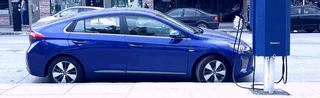 An EV charging at a public station in Montréal
Résumé
In the last few years, several studies have considered different variants of
the Electric Vehicle Journey Planning (EVJP) problem that consists in finding
the shortest path (according to time) between two given points, passing by
several charging stations and respecting the range of the vehicle. The total
time taken by the vehicle is the sum of the driving time, the charging time
and the waiting time. Unfortunately, the consideration of the waiting time has
been neglected by previous studies. This study aims to fill this gap by
introducing: (1) a graph relabeling technique using a probabilistic model of
charging station occupancy generated using real EV stations data; (2) an
alternative paths generation technique which accounts for worse than expected
waiting time at various charging stations. Our empirical results indicate that
the a priori consideration of charging station occupancy by graph relabeling
can reduce the waiting time by more than 75%, while having a negligible impact
on the driving time, and that the generation of alternative paths helps reduce
the waiting (and total) time even more. For our public station network dataset
and the current station occupancy (for now quite low), the mean total journey
time (computed over 1000 requests) decreased by 17.3 minutes when our new
technique was used.
Type
Publication
Proceedings of the 27th ACM SIGSPATIAL International Conference on Advances in Geographic Information Systems

Auteurs
Chercheur postdoctoral en informatique
Je suis actuellement chercheur postdoctoral en informatique à l’Université
TÉLUQ, où mes travaux portent sur l’accélération de la conversion de nombres
entiers et flottants en chaînes de caractères décimales. Au cours de mon
doctorat, j’ai conçu des algorithmes et des structures de données exploitant
l’architecture moderne des ordinateurs afin de résoudre de grandes instances
de processus décisionnels de Markov (MDP). Durant ma maîtrise, j’ai développé
des algorithmes de planification d’itinéraires pour véhicules électriques,
visant à déterminer le chemin optimal entre deux points tout en minimisant
le temps total du trajet (déplacement, recharge et attente aux bornes).
Auteurs
Auteurs